Memories of a snowy day in Cheshire
Author
- Lorenzo Baer
Date
- December 22, 2025
Related articles
- Ian Ashley - An interview with..., by Darren Galpin
- Goodwood - Through the ice and snow, 76th GRRC Members' Meeting report, by Mattijs Diepraam
- Tazio Nuvolari - Mantua's Great Little Man, by Leif Snellman
- Teddy Pilette - Third generation of a racing family, by Mattijs Diepraam/Leif Snellman/Felix Muelas/Eric Verkaaik
- David Purley - Army heroics to car heroics, by Marc Ceulemans
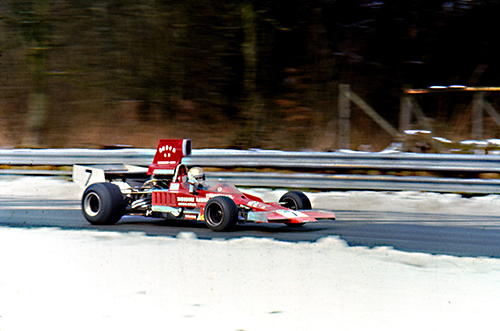
Who?Dave Walker What?Chevron-Chevrolet B28 Where?Oulton Park When?1975 Bank Holiday Oulton Park 5000 |
 |
Why?
In motorsport, a race can go down in history for several reasons. They can be related to on-track circumstances, such as the victory of an underdog, a spectacular overtake, a tragic accident or a decisive strategy, or they can be due to off-scene factors, such as heated discussions in the paddock, reviews of results made by stewards or even a team breaking the rules, which can change the face of a race before it starts or even after it has already been concluded.
Another factor that can turn a normal race into an epic tale is the weather conditions. Tazio Nuvolari's victory at the 1935 German GP under appalling rain is perhaps one of the most famous cases of weather conditions interfering with the outcome of a race. Another extreme case that illustrates this situation well is that of Ayrton Senna in the 1993 European Grand Prix, where the driver, in extreme damp conditions, made one of the greatest demonstrations of skill ever shown in F1.
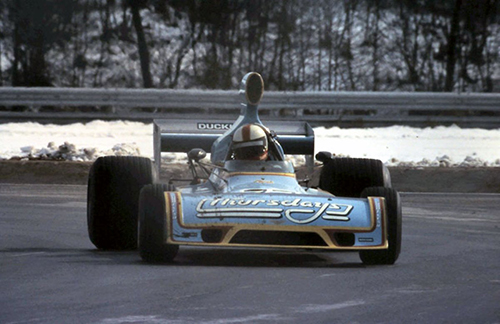
Formula cars and snow: a peculiar mix at Oulton Park. (credits Alan Cox)
A much less commonly associated weather condition with single-seater motorsports, however, is snow; but even so, it has already given her grace in some specific situations. The most emblematic of these is certainly that of the 1973 BRDC International Trophy, a joint race of F1 and F5000 cars where Scottish driver Jackie Stewart became the winner in the midst of a blizzard!
However, this would not be the last time that a single-seater race would take place in snowy conditions, at least in England. For the second round of the 1975 Shellsport F5000 Championship, at Oulton Park, an icy surprise awaited drivers and teams, giving a special touch to this event. It was Formula 5000 on snow, on one of the most renowned circuits in the British isles – it would be an unprecedented test of skill in the series, with the weather calling the shots in this memorable meeting.
Ups and downs: the complex story of F5000
Having its roots in the American Formula A, F5000 became a major phenomenon in Europe in the late 60s. In addition to England, which hosted most of the F5000 in this first phase, other countries such as Ireland, Belgium, Germany and the Netherlands also participated in this process of consolidation of the category. At its peak, in the early 70s, F5000 gained great relevance, almost surpassing Formula 2 to take second place as the most important single-seater category on the world stage.
Not only did F5000 stand out in the competitive aspect, but also, much of the category's success was due to its commercial and economic appeal. As the costs of Formula One soared, with teams like Ferrari, McLaren, Tyrrell and Lotus having colossal budgets compared to other smaller squads, F5000 offered a more affordable alternative in which the financial resources were more fairly distributed among the grid. Since the engines were basically the same for all arrays (99% of the 1970s F5000 powerplants were V8 Chevys) there was little discrepancy in parts, which greatly reduced teams' costs.
The financial contribution of the tycoon Rothmans, from 1971 onwards, was also another critical factor in the history of F5000. The change of naming rights (which had previously belonged to Carreras Tobacco Co., through the Guards Cigarette brand) was just a clearer consequence of the injection of resources that the company dumped in the category. Much of the F5000's structure was already on solid foundations. Therefore, all Rothmans had to do, right after the takeover, was simply improve an already very attractive product.
Despite this initial boost, the period after the Rothmans takeover can be considered the 'weary years' of F5000; and, in 1975, all the bonanza of the early 70s had practically disappeared from the category's scene. The first sign of the problems that were to come happened in 1972, when Surtees and McLaren pulled out from F5000. Both were now focusing on their ventures in other more 'attractive' categories, especially F1.
From the vacuum left by these constructors came forward the second factor that would contribute to the downfall of the series. Other F5000 constructors, such as March and Chevron, failed to capitalise on the drivers left without a drive through the departure of their original chassis providers, with both companies being quickly pushed aside by Lola, which stormed the series with its successful T300 and T400 models. By the end of 1974, F5000 had practically become a single-make championship, with Lola becoming the dominant power in the series. As a result, drivers who did not yet own a car from the British constructor found themselves almost forced to buy a Lola chassis if they wanted to have a slight chance of success in the series.
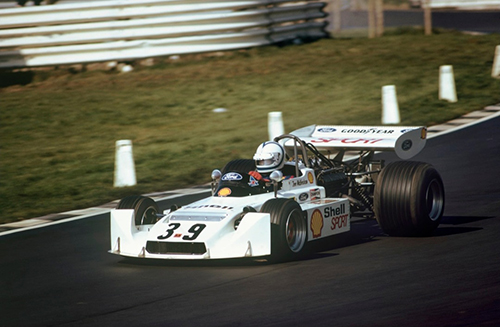
The unique Modus M5. This car would participate in only four races, before being completely
destroyed by Walkinshaw at Zolder. (credits unknown)
The third blow to F5000 was the progressive increase in the purchase and maintenance costs of American V8 engines, which suffered each new fiscal year with an adjustment in import taxes. Each time this happened, the economic advantages that previously existed in relation to other similar categories, such as Formula 2, were further reduced. Not even the late introduction of the more cost-efficient GAA V6 Cosworths could minimise this problem.
A fourth (but more indirect) factor that can help to understand this period of decline of F5000 was the 1973-'74 international oil crisis. As F5000 raced with the monstrous (and far from economical) American blocks, it was simple to predict that an increase in fuel prices would be a clear signal to 'move on', causing many small teams to rethink their operations in the category.
Seeing the F5000 ship slowly sinking, Rothmans decided to pull out its financial support at the end of 1974, thus ending a four-season partnership that saw the high point but also the beginning of the category's decline. As an urgent measure to save F5000, in 1975 the British Racing and Sports Car Club (BRSCC) and the Motor Circuit Developments (MCD) established a partnership with the motorsport-specialised agency Motor Race Consultants (MRC). The company offered a life-saving package for the series, bringing with it the sponsorship from oil company Shell, which would assume the naming rights of the category at the termination of the Rothmans contract.
As in 1971, an optimistic scenario lay ahead: MRC was one of the most experienced companies in the automotive event promotion segment at that time, having helped in organising F1 events in Spain and Brazil, as well as other F2 and F3 races in France, England, Argentina, Brazil, Colombia and Israel. The company's complete portfolio not only included this sporting know-how, but also encompassed other 'administrative duties'. In other words, the company provided the link between race organisers on one side of the spectrum and drivers and teams on the other.
The first test of the new arrangement took place on 15 March 1975, in the Brands Hatch Shellsport F5000 meeting – and the final result was far from what was initially expected. Only two cars would complete the full 35-lap race distance, with Ian Ashley taking victory with a large advantage over second-placed David Purley. However, a good omen was provided by Purley himself who, having the only Ford V6 on the grid, was one of the few to take the fight to Ashley – demonstrating the degree of reliability that the aforementioned engine had already achieved.
However, this was just the first experience, and it was certainly too early to draw conclusions from this new face of the category. A second test was necessary, so that the observations about the successes and errors of F5000 could have a real basis. The destiny? Oulton Park, second stop of the 1975 Shellsport 5000 European Championship.
Contenders for the Bank Holiday event
The driver who appeared as the main candidate to win the Oulton Park race could not be anyone other than Ian Ashley himself. His superb performance at Brands Hatch was just one of many that the driver had achieved in F5000 so far, and which had given him third in the final standings of the 1974 championship.
For the 1975 edition of the series, the driver switched sides, dropping ShellSport Luxembourg in favour of Richard Oaten Racing. However, one thing that hadn't changed was the car, which continued to be the same Lola T330 (Chevrolet/Fewkes) chassis number HU17 – the vehicle that had already given Ashley victories at Jyllandsringen, Thruxton and Oulton Park in 1973 and 1974. The combination had proven to be very efficient, especially when compared to the very competitive F5000 environment.
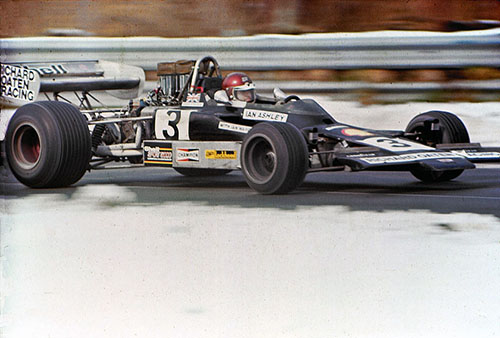
Ian Ashley was the great favorite for the race at Oulton Park. But the unexpected snow in the Cheshire circuit was an unpleasant surprise for the driver. (credits Alan Cox)
Ashley's main rival in the season opener would also make his move to the Oulton Park circuit. After a 1974 dedicated to F1 and F2, David Purley made his debut in Formula 5000 aboard a Chevron B30 (Ford). The Briton's car was unique, built over a shortened Formula 5000 B28 chassis with the aerodynamic package of a Formula 2 B29. Purley was sponsored by Lec Refrigeration, a company founded and managed by his father, Charles Purley.
The driver had a good stint in 1974, with the highlights being three second places in F2 events, achieved at the IV Festspielpreis der Stadt Salzburg, the XII Gran Premio del Mediterraneo and the XXII Grand Prix of Rouen. A new second place in the first F5000 race of 1975, in Brands, was a sign that Purley's good streak was to carry on…
One of the main threats to Ashley and Purley would certainly materialise through the VDS team, made up of the experienced duo of Peter Gethin and Teddy Pilette. Between 1973 and 1974, the team had acted as the Chevron works team using the British manufacturer's B24/28 models, until the latter decided to officially withdraw from the category at the end of '74.
This urged team owner Count Van der Straten Ponthoz to look for a new partner, and Lola, already the leading F5000 manufacturer at the time, came as a solution to this problem. The promise was that Lola would supply its most advanced products to the team, as long as it became a semi-works effort of the British constructor. The deal was done and Lola answered the VDS request with the T400 model. Equipped with a specially tuned Chevy V8 engine by Morand, the car offered a completely new suspension system, rearranged radiators and more refined aerodynamics.
At that point, Peter Gethin was one of the most capable and experienced drivers in motorsports. In open-wheel single-seaters alone, Gethin had driven for the McLaren, BRM and Chevron factory teams, with Lola/VDS being his fourth official team in this specific type of motorsport discipline. In F5000, he had already made history, being not only the first driver to win the category's European Championship in 1969, but also the first to achieve a double in 1970. Furthermore, the driver had clinched a third category title in 1974, but this time in the Oceania F5000 series (Tasman Cup).
Teddy Pilette also needed no introduction. A VDS driver since the late 60s, the Belgian had participated mainly in endurance races until 1971, when the team's operations expanded to F5000. The pilot quickly demonstrated his talent in this discipline, winning the highly contested 1973 European F5000.
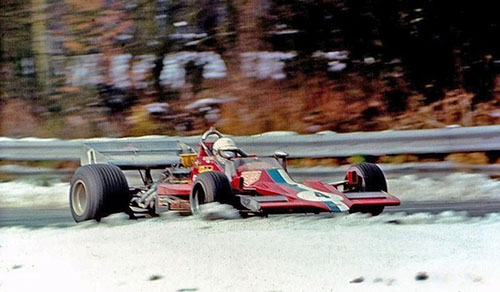
Teddy Pilette tried his best to control the brand new T400. However, the car proved too aloof in
the extreme conditions of Oulton Park. (credits Alan Cox)
Next in the line was the A.G. Dean team, composed of the seasoned duo Tony Dean and Brian Redman. Besides being the true owner of the squad, Dean was a very qualified driver at the time, having participated in WSC, Can-Am, F Libre and F3 races, especially in the United States and Great Britain. His greatest result in 1974 was a victory in the August Brands Hatch F5000 race.
On the other hand, Brian Redman was a natural racer in his own right. His impressive CV, which included successful spells at Ferrari, Matra, John Wyer and so many other top motorsport teams of the time, was enough to ensure that Brian was one of the most qualified drivers present at Oulton's F5000 meeting. In addition to all these laurels, Redman was the reigning US F5000 champion and would go on to achieve a treble in the series by 1976.
Australian Vern Schuppan was another who could be a headache for the big players on the grid. By 1975, the driver had participated in races in Europe, Americas, Asia and Oceania, collecting a multitude of fine results in both single-seaters and sports prototypes In 1974, the driver finished on a high note, winning the last round of the European F5000 championship at Brands Hatch.
A lesser known name on the grid but one who could spring a surprise was Gordon Spice. Best known for his role in founding Spice Engineering in the 1980s, Gordon began his automotive career as a simple saloon car driver in England in the mid-1960s. The driver had a very uneventful year in 1974, having competed in only two events of a reasonable scale – the Thruxton Rothmans 5000 and the BTCC Martini International Meeting – finishing neither due to mechanical problems. However, 1975 would be Spice's turning point, with new contracts with Wisharts Garages (saloon cars) and Reed Racing (F5000) guaranteeing a solid yearly schedule. In the specific case of F5000, Reed Racing provided the driver a Lola T332 (Chevrolet/Fewkes).
On the entry list for Oulton Park, another driver creating expectations was Tom Walkinshaw, who would take a new Modus M5 to the circuit. Except for Purley's Chevron, the Modus was the only other car on the grid equipped with the Ford GAA engine, and no one knew for sure how the vehicle would perform in real race conditions. Much of Modus Cars' success and experience came from its first single-seater car project, the M1, intended for Formula 3.
Despite being a conventional and unremarkable car, the M1 proved to be a reasonably successful machine in the series, opening the door for the M3, built for Formula Atlantic. The next evolutionary step was the M5, the constructor's first foray in a higher-level Formula. The company ended up building two M5 chassis – the prototype, known as M5-003 (based mostly on a rebuilt M3 – and which was later destroyed by Walkinshaw himself at Brands Hatch in October 1974) and a new chassis, numbered 021-F5 (the 1975 car).
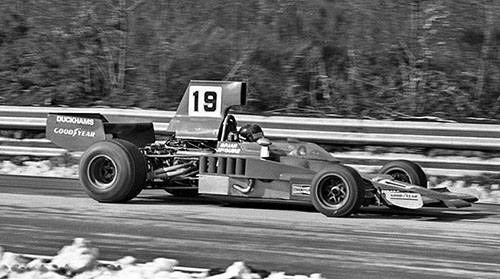
With his Lola T332, Brian McGuire made a discreet appearance at Oulton Park. (credits Gareth Roberts)
In addition to these, other good names would be part of the entry list for the Shellsport F5000 Oulton Park meeting, such as Dane Tom Belsø, driving a Lola T330 (Chevrolet/RES) for the EMI-Radio Luxembourg Team. Meanwhile, F1, F5000 and WSC veteran Guy Edwards would drive a Lola T332 (Chevrolet/Smith), sponsored by The Encyclopedia Brittanica. Racing as a privateer, Brian Robinson, another well-known figure from the F. Atlantic, F5000 and WSC paddocks, would be behind the wheel of an ex-F1 McLaren M19C, adapted to F5000 with a Chevrolet/Close. And finally Dave Walker, a former Team Lotus driver who would now pilot an ex-VDS Chevron B28 (Chevrolet/Morand) for RAM Racing.
Other lesser known names such as Dennis Leech (Chevron B24 Chevrolet/Leech), Trevor Twaites (Lola T330 Chevrolet/Fewkes), Richard Scott (Lola T400 Chevrolet/Whitehurst), Brian McGuire (Lola T332 Chevrolet/RES), Leen Verhoeven (Lola T330 Chevrolet/Fewkes) and Damien Magee (Trojan T101 Chevrolet) added the final numbers to the entry list, totalling 19 drivers and cars.
The practice sessions
As the race would take place on Easter Friday, 28 March, most of the drivers arrived at the track between Wednesday night and the early hours of Thursday morning, hoping to be able to participate in the first practice sessions. Although the weather during the previous week was by no means 'friendly', with gusts of wind, cold and humidity, few expected that the Oulton Park circuit on qualifying day would be covered in snow.
The weather conditions were just another complication for the drivers of the Bank Holiday 5000. Between 1974-'75, the track had undergone a revitalisation process through the repaving of some sections and changes to the radius of several corners. However, the change that would most impact the upcoming race was the choice to use the new Forster's layout. Inaugurated just in time for the event, the new layout bypassed the old loop that culminated at the famous Shell Oils corner, through a new corner that connected the Cascades bend to the end of the Hilltop straight.
With a new layout and adverse weather conditions, many drivers were left wondering about the worthiness of the event. Meanwhile, stewards and members of the BRSCC were engaged in the gruelling task of cleaning the entire route, racing against the clock to ensure the track was in decent condition as soon as possible. The effort would not be in vain, however, with the BRSCC assessing that the track had been sufficiently cleaned by late morning – despite a substantial amount of snow still being found in the run-off areas of the track.
As the green light was given, most drivers opted to use wet tyres for qualifying, while the more daring tried to see how their machines would behave with improvised intermediate tyres, which were simply hand-carved slicks with generally three, four or even five horizontal grooves.
The snow provides an interesting backdrop for the image, which features Dave Walker's B28 as its protagonist.
(credits John Leck)
Dave Walker proved to be one of the most comfortable drivers with the situation, setting excellent times with his B28. Powered by a Chevrolet V8 tuned by the Swiss company Morand, Walker's Chevron performed regular laps around the 1.07 mark until achieving a spectacular time of 1.06.6. Tom Belsø also didn't seem to mind too much about the cold and slippery surface, fighting an exciting duel with Walker on the timesheets. The Lola, powered by a Race Engine Services (RES) Chevy V8, behaved very well in the extreme conditions present on location.
Despite Belsø’s best efforts, however, he was unable to surpass the 1.07 mark, leaving him four tenths behind leader Walker. Purley, one of the few drivers to attempt laps on intermediate tyres, quickly regretted his decision after a couple spins seriously compromised some of his best laps. A quick stop in the pits and putting on a fresh set of wets was enough to correct this problem.
Soon after the change, the driver's performance improved substantially, and in the final moments of qualifying a flying lap of 1.07.2 was enough to promote Purley from fourth to third, thus guaranteeing the last remaining spot on the front row. The driver most unhappy with this was Ian Ashley, who had been displaced from this honourary position when he was unable to answer. Despite this, fourth best time of the day could still offer a good starting position, as it meant starting behind the pole-sitting Walker.
On the other hand, the VDS team had a miserable qualifying with their Chevrolet/Morand-powered T400s, with Pilette and Gethin having all sorts of issues during the session. The cars did not generate enough downforce, something extremely necessary not only on the winding Oulton Park circuit, but also for getting a grip on the frozen tarmac. The factor that made the T400s struggle at the beginning of their journeys in F5000 was not mechanical, but rather the mechanics' and the team's lack of understanding of the new technologies embedded into the design. The rising-rate suspension, with rocker arms and inboard springs, was something unseen in the category before, causing confusion among the team's technicians, which consequently hampered the performance of these machines.
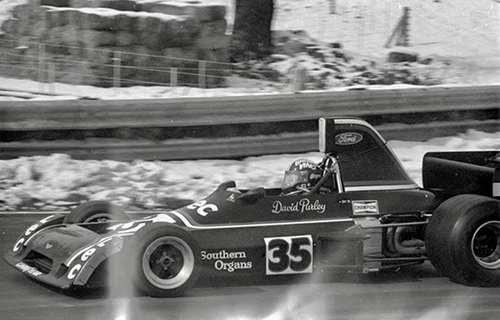
David Purley tried his first practice laps on 'intermediate tyres'. At the time, this type of tyre was made by carving grooves into the slicks, an extremely dangerous practice that would be criminal in today's motorsport. (credits Nick Taylor)
Because of this, Teddy Pilette had to settle with 11th on the grid with a time of 1.12.0, while Gethin with a 1.14.1 would start in a terrible 16th place. The other T400 entered in the race, driven by Scotsman Richard Scott, also failed to have a great day, as after problems with the car's fuel pump, the driver only managed to set 13th fastest time with a 1.12.8. An interesting detail is that unlike the VDS cars, Scott's Lola was powered by a Chevrolet V8 engine tuned by the English firm Whitehurst Racing.
The surprises in the result sheets were Damien Magee and Brian Robinson. The first, driving a Trojan 101 (Chevrolet), which in less than two years had been raced by Brett Lunger, Vern Schuppan and Leen Verhoeven, managed to overcome strong opposition from Lolas and Chevrons, taking seventh overall. Robinson, on the other hand, had a more modest but still surprising result, as his heavily modified 1972 McLaren lifted him to 10th on the grid, and ahead of much more modern cars than his own M19C!
As the time went by, weather conditions once again worsened over the Oulton Park circuit; and, a few minutes before the end of qualifying, snow began to fall, forcing once more the closure of the track. One postponement followed another, until it became clear, in mid-afternoon, that the snowfall was not going to give a fresh respite. As the drivers and teams retreated back to their garages, the ballet of tractors and snowplows from the BRSCC returned to the track. All sides had optimism on their faces that the weather would cooperate for the final race, scheduled for the following day.
Racing on snow
Easter Friday dawned sunny at Oulton Park. Even so, a reasonable layer of snow covered the place and there was little chance that the track would be in conditions suitable for hosting the event. Therefore, the BRSCC appealed to most of the track marshals – and even some volunteers from the crowd! – to take their cars for a few laps around the track in order to create a trail that would be minimally suitable for the F5000 cars.
In the end, the joint effort paid off, with marshals and the sun each doing their part. Shortly after noon, the track was declared to have minimum drivability conditions. Without waiting a single minute more, the vehicles were pushed to their respective starting positions – and at this point, strategy began to be an essential factor, which would certainly define the outcome of the event.
Since the conditions present on the track were so peculiar, the drivers and teams wondered what type of tyre would be ideal for the race. Well, even though the melting of the snow began to accelerate, the tarmac was not wet enough for rain tyres to be 100% recommended. However, the existing puddles, together with a few patches of tarmac still covered by ice, promised a serious challenge to anyone trying the slicks alternative.
There was no consensus between drivers and teams even after they were allowed to perform some warm-up and reconnaissance laps around the circuit, minutes before the official race. So each team faced the problem in its own way: for example, Tom Belsø and the EMI-Radio Luxembourg Team chose to equip their Lola T330 with four slick tyres. The VDS team had done just the opposite with their two cars, putting a full set of wets on them. David Purley, on the other hand, chose to go with improvised intermediate tyres (as did Schuppan, Dean and Scott). Meanwhile, other drivers were even more radical – like Dave Walker, who decided on a combination of dry tyres at the front and wet tyres at the rear.
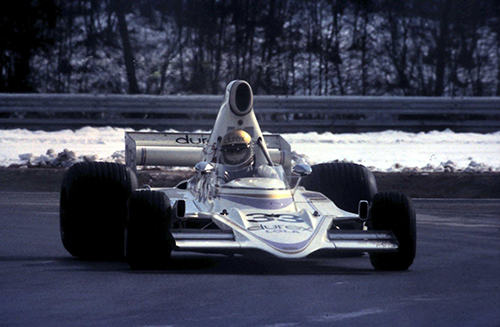
Richard Scott drove the only real privateer Lola T400 in the Oulton Park meeting, for the McKechnie Racing/Durex team. (credits John Leck)
18 of the 19 entrants lined up for what promised to be an exciting 50-lap contest - the exception of the group being Damien Magee, who after an excellent practice session had mechanical problems on his Trojan. With the thermometres rising just above 0ºC, the starting signal was finally given and Purley was the one who jumped ahead, moving directly from third to first. Clinging firmly to second was Belsø, who found lots of traction on his slicks.
Walker was less fortunate. A poor start cost him three positions, as he took the first corner in fourth. In addition to Purley and Belsø, he was also overtaken by Ian Ashley. However, the RAM team driver would not allow himself to be beaten so easily, and before Forster's Corner, he had moved back up to third after repassing Ashley.
On the other hand, Pilette proved that his choice of wet tiyes could also bear fruit. Chasing the moist side parts of the track, the driver quickly climbed positions, being fifth by the end of the first lap. Meanwhile behind, other changes were happening: Tony Dean had also managed to make a jump, already being among the leaders before Lodge Corner, while on the other hand, Dennis Leech, who was already well behind in the standings in 15th, dropped to second-to-last position after taking a walk through the snow at Forster’s Corner.
Before the end of the first lap, another big change in the field: going up Dear Leap, Ian Ashley's Lola spun and overturned, stopping only at the Armco barrier of Old Hall Curve. Despite seriously damaging his vehicle, the Richard Oaten Racing driver emerged unharmed from the accident. It was later verified that the cause of the incident was a broken rear driveshaft.
This allowed Pilette to gain another position, in the spectacular rush that the driver presented to the crowd at the beginning of the race. So, we had in order: 1st, David Purley; 2nd, Tom Belsø; 3rd, Teddy Pilette; 4th, Dave Walker; 5th, Vern Schuppan; 6th, Tom Walkinshaw. Gordon Spice, who had dropped to eighth at the start, began to set an impressive midfield pace, having already recovered lost ground, and now was back to his original starting position of sixth. An important detail is that Spice had rain ttres (a decisive factor, as will be discussed below).
On the second lap, the field was already splitting up into small groups: Purley, Belsø and Pilette were distancing themselves in the first positions, while Walker, Schuppan, Walkinshaw and Spice were battling for fourth and lower. Continuing his withering charge, Gordon Spice had overtaken his two direct rivals before the start of the third lap, and the Briton didn't stop there, with Belgian Pilette and Dane Belsø quickly coming into his sights.
Spice's attacking style proved to be so simple and effective that on lap 4, he was up behind Purley, with a beautiful duel developing for the lead of the race. A few positions behind, Dave Walker was also doing his part. Taking advantage of his rain tyres, which now provided perfect traction on a soaked Oulton Park track, the driver resumed his position among the leaders after overtaking both Belsø and Pilette.
Calm reigned on the fifth lap, with no changes at the front. However, this peace was ephemeral, as on lap 6, major changes affected the general face of the field. Redman, who had narrowly escaped being involved in Ashley's accident in the first moments of the race, abandoned the contest due to enduring challenges of visibility and drivability. But the most important moment of the lap happened when Gordon Spice dispatched with David Purley to snatch first place, effecting the first lead change in the race. However, a side effect of the move and the preceding duel between both drivers was that it allowed other contenders to close in, such as Pilette.
His first victim was Tom Belsø, who started to have stability issues when his slicks became increasingly useless on the wet track. Soon after, it was time for revenge, as Dave Walker became the next target for Pilette. Next on the list were Purley and Spice, who lost their positions to the Belgian until lap 8.
Meanwhile, Tom Walkinshaw had a surprising race in the Modus, managing to reach fifth. The situation became even more spectacular when the driver moved up into fourth after an unexpected overtake over Dave Walker, before the 10-lap mark. However, the Modus driver's happiness was shortlived as less than three laps later the car's Ford V6 engine seized, forcing Walkinshaw to retire from the race.
Another driver having difficulties at the same time was Peter Gethin. Starting in 16th position, the driver was unable to adapt to the new T400 and if that wasn't enough, the car itself didn't help the experienced British driver. Firstly, a spark-plug issue in the engine and then a flat tyre basically conditioned that this would be a protocol race for Peter. Gethin, always accustomed to being one of the protagonists in a race, would only have a supporting role in this event.
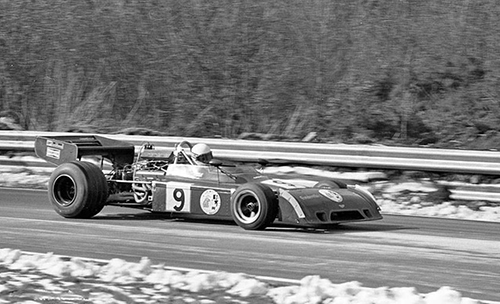
Brian Redman, pictured here at the Oulton Park race, would drive a Chevron B24/B28, while Dean would have a standard B24. Both cars were equipped with Chevy/Morand engines. (credits Gareth Roberts)
As the laps followed, the snowbanks started to dwindle, providing an increasingly greater coefficient of difficulty for the drivers. Melting snow flooded the circuit, providing the final answer to the tyre dilemma: those who had decided to opt for wets had made the wiser choice, the greater traction of grooved tyres proving essential to exiting the more treacherous corners.
Because of this, Pilette and Spice began to distance themselves from the rest of their pursuers from lap 10 onwards, while Walker and Purley were increasingly adrift from the lead fight. Other drivers who had chosen to put on wets before the start, such as Guy Edwards and Brian Robinson, took advantage of the situation: the former had no difficulty in lifting his Lola to third place, while Walker and Purley struggled to keep their cars on track.
Robinson, on the other hand, was more conservative, preferring to stay behind the British duo. In the end, the driver's strategy also paid off as Walker (who at that point had dropped to fifth) accepted the failure of his choice for a mixed combination of tyres, heading for the pits on lap 26 to exchange them for a full set of rain tyres. The driver returned to the track behind Brian McGuire, thus dropping out of victory contention.
By that point, Oulton Park had completely transformed, with the track itself resembling a river more than a place to go motor racing. On the sides of the circuit, some pockets of snow still resisted the sun's impetuosity, which was turned down a little solely by a cold wind blowing over the Cheshire heartland. On lap 35, the last significant change of the race took place: Teddy Pilette had to abandon his plans for victory after an electrical issue forced the Belgian into an unscheduled stop. The seconds spent changing the car's battery in the pits were decisive in ending the driver's ambitions, who resigned himself to finishing the remaining laps of the race.
So, first position fell into Gordon Spice's lap and that of his Lola T332, now more than 15 seconds ahead of the second-placed Purley. On the other hand, Guy Edwards remained firmly on Purley's heels, despite the Lola-Chevrolet driver being equipped with the most suitable rain tyres, while his rival on a Chevron-Ford had intermediates to deal with.
The battle between Edwards and Purley continued throughout the final part of the race, with the decisive moment of the duel coming on lap 47, when, in a moment of distraction, Purley lost control of his car and spun in Forster's Corner. Although the driver quickly recovered from his mistake, losing just a few seconds, it was enough for Guy Edwards to sweep in and take second spot – a position that the driver would hold until the chequered flag.
Due to this, Gordon Spice had no trouble in consolidating first position in the race, and at the end of 50 laps, the Briton crossed the finish line almost 25 seconds ahead of second-placed Edwards, with Purley rounding out the podium. Only these three drivers completed the full race distance, with Brian Robinson (fourth) and Trevor Twaites (fifth) being the closest in contention. Despite their problems, Pilette and Walker managed to make good recovery runs, finishing in the middle of the field.
Oulton's aftermath
Spice's victory at snowy Oulton Park gave the driver his first success, not only in Formula 5000, but also in any category of minimal relevance on the international scene. Despite his triumph, it would prove to be an exception in his F5000 career, as in the following races of the championship, Spice would only manage to achieve modest results – the best of which was fourth in the Shellsport 5000 round at Zandvoort. For 1976, Spice would abandon his ambitions of repeating his sole win in the series due to his increased focus on the British and European Touring Car Championships.
While the Oulton Park winner would lose pace throughout the year, other drivers fought hard for the category title in the following F5000 rounds. In the next round at Brands Hatch – which took place just three days after the race at Oulton! – David Purley and the Ford V6 engine finally achieved their first glory in F5000.
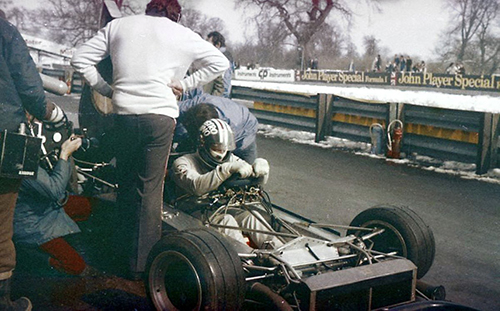
A nice picture of Purley's B30, taken at Oulton Park. (credits John Fenton)
As for the snow in Oulton Park, that's another story. As far as this author knows, this was the last race in an international single-seater series to be held in snowy conditions. Although the phenomenon came to disrupt some other editions of the European F2, F3 and F5000 national championships, all affected races were either cancelled or rescheduled before the drivers could even challenge themselves in these hostile conditions.
Much of this is due to the tightening of motorsport competition regulations, which have become increasingly strict in relation to events in adverse conditions. As the word 'safety' became synonymous with motorsport, it was only a matter of time before races like the one held at Oulton Park in 1975 or the Eifelrennen in 1967 became snapshots of a lost time in the history of racing.